

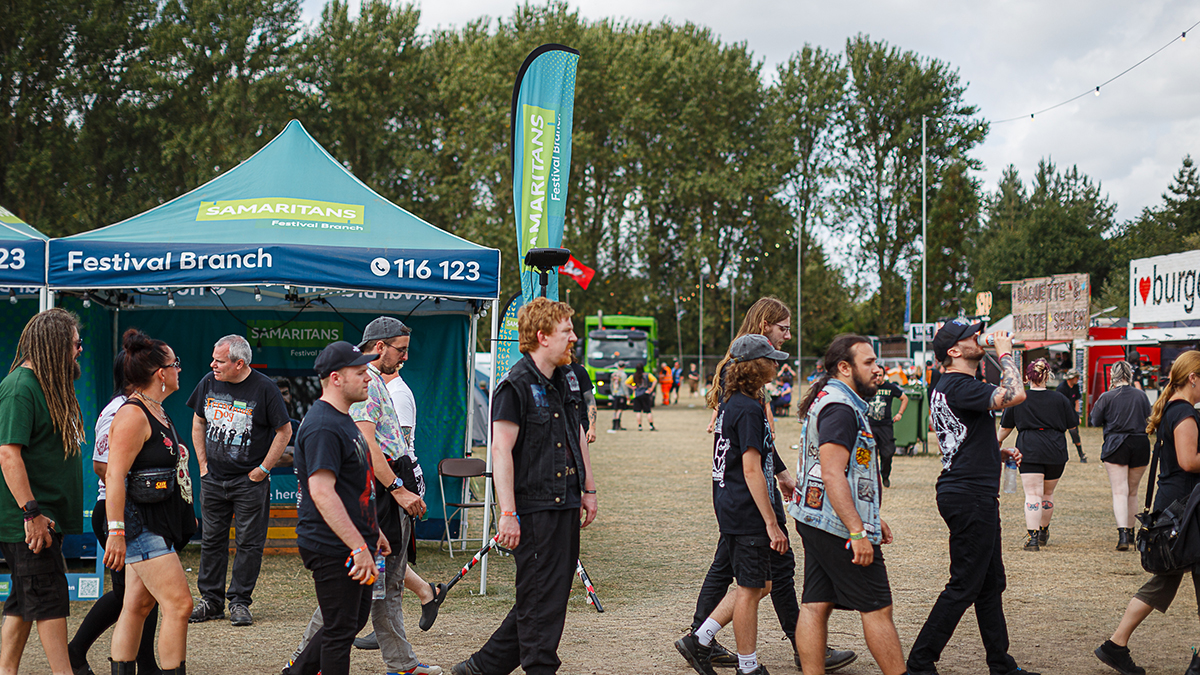
Most people have heard of Samaritans. Whether it’s from the posters we see at train stations or their bright green logo, the suicide prevention charity has evolved into a vital service for millions from its founding in 1953. What most people might not realise is that the Samaritans have had a presence at festivals since the 1970s.
While the Samaritans has more than 200 brick-and-mortar sites across the UK, the Samaritans Festival Branch initiative is the only one without an office or phone line. Starting in Glastonbury in 1973, Festival Branch was set up with the aim to reach more communities on the ground and be as accessible as possible.
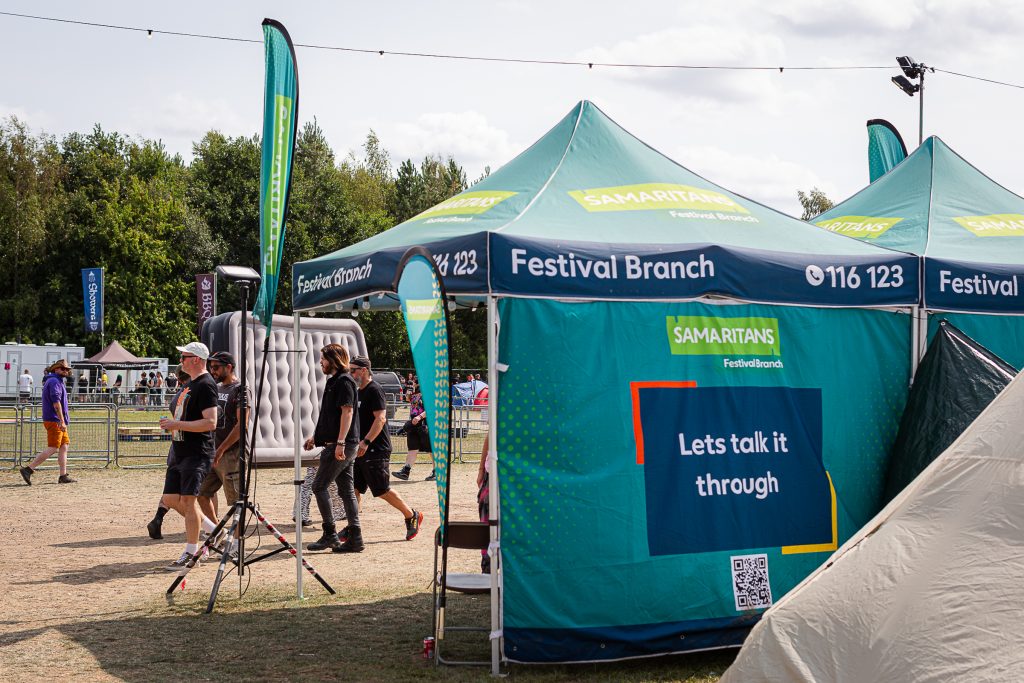
Through the Festival Branch, Samaritans offer 24 hour support, rain or shine, at festivals with a tent staffed by trained volunteers who are there to help anyone in crisis, from festival-goers to backstage crew. The initiative has now visited more than 500 festivals with 24 shows on its calendar for 2026, including Download Festival, Bloodstock, Boomtown and Latitude.
Sally Washtell-Blaise is the Samaritans’ deputy director of communications and fundraising. She started on the phone lines at the charity in 2018 and then joined Festival Branch in 2022. Although she found it initially challenging with camping and being in person, she quickly became part of the Festival Branch family. Now, she helps bring the Samaritans’ presence and support to weekenders across the UK.
Sally’s festival work is an ongoing effort in a challenging environment. Festivals are hedonistic spaces but come with pressures and potential triggers. They encourage you to switch off for a weekend, but that’s far easier said than done.
It’s reasons such as these that explain why the Samaritans’ festival work continues to provide a vital service in the field. To delve further into this, Sally tells us why their services should be treated as an essential part of festival infrastructure, not just an afterthought.
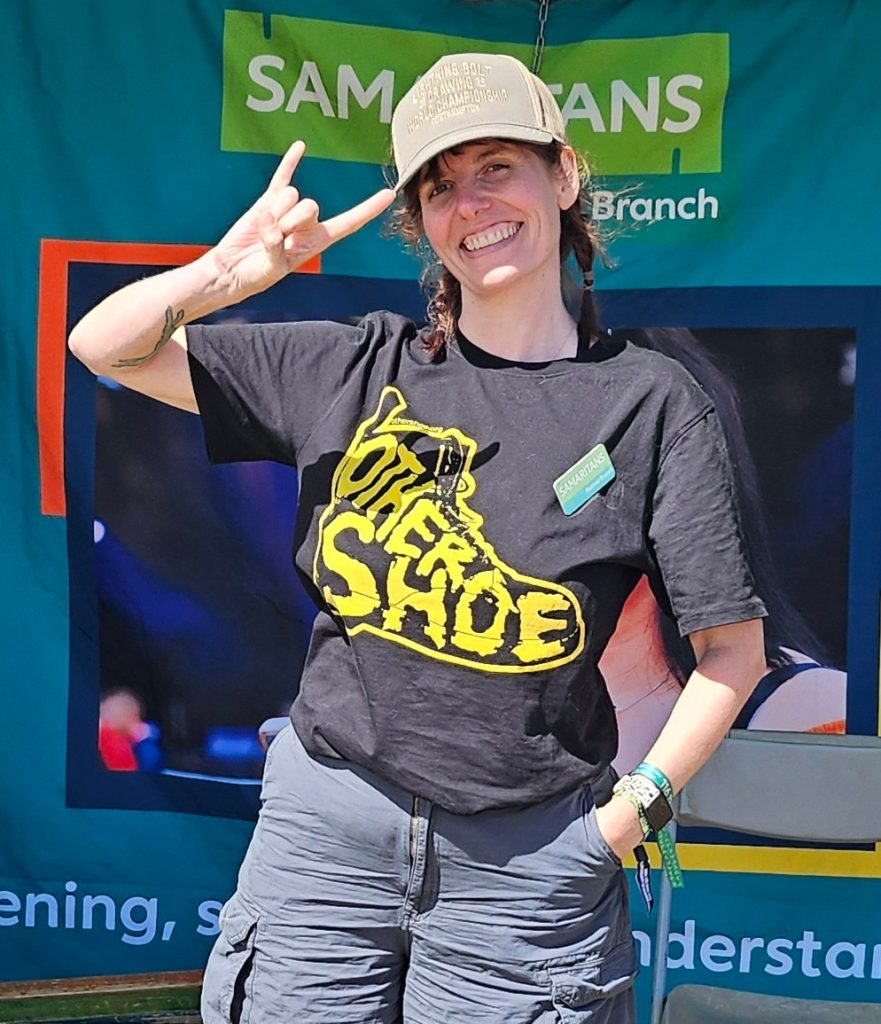
“Someone catches your eye across a crowd. A slight nod, nothing more. Sometimes that’s the whole encounter. They know we’re there and that’s enough, and they walk on. Other times, someone jogs over to ask where the toilet block is, and ten minutes later they’re telling you they’ve been struggling with depression all summer and haven’t told a single person.
That’s what it’s like being a Festival Samaritan.
Festival Samaritans is a branch of Samaritans, the suicide prevention charity most people know from the phone line. We’re volunteers, trained the same way any Samaritan is trained, except our patch is fields and campsites rather than a phone in a quiet room. We’ve been going to shows since 1973.
I still find it hard to explain to people who haven’t spent time at a festival why we have Festival Branch specifically. I think the environment just does something. You take away someone’s normal routine, put them in a tent next to strangers, take away the usual buffers of home and work, and somehow it gets an intensity that nobody really expects when they booked the tickets ten months earlier.
Things surface. A crew member might come over furious because they’ve just done sixteen hours guarding a gate in the rain and nobody believed how bad it was. A punter might come over in tears because they overslept and missed the one act they’d really wanted to see. And then, once that’s out, something else comes with it. A relationship that’s ended. Exam results they’re waiting on at home. A business that’s failed and has to be faced again on Monday.
At every one of these, some people just want to know who we are, a hello and a quick word about the service. Last year we spoke to around 8,000 people across 13 shows, and a good many of those went further than that, sat down and actually told us what was going on.
People come back to us more than once over a weekend sometimes. Some sit with us for hours. Some are with us ten minutes, have a cry, say thanks, I needed that, and go back to find their mates. This year we’re covering 24, nearly double last year’s number, so whatever that adds up to, it’s a lot more conversations like that.
Sometimes people tell us they’re having thoughts of suicide. We’re Samaritans, so we ask, gently and directly, when it needs asking. I’m not going to put numbers on it here, it’s not our place to make headlines out of what people tell us in confidence. But Vicky Hungerford, director of Bloodstock, has seen it from her own festival’s side.
She knows of times when having Samaritans on-site has prevented suicide, including people who messaged the festival afterwards to say Samaritans got them through a dark moment and that they went on to seek help once they were home. As she put it, even if it’s just one person, that’s everything.
None of us are there for the ticket. I know it can look like a cheeky way in, but it isn’t. We cover the site round the clock, on shifts of a few hours at a time, and in between we’re cooking for each other, trying to sleep before a night shift, doing training year round so we’re ready. Some of the best moments are coming off a night shift, rain all night, five in the morning, walking back across the campsite with the rest of the team as the sun comes up. It’s the most peaceful the site ever feels.
We do get downtime, but nobody can promise themselves they’ll catch the one act they came for. It’s a job in a field, much like anyone else working on site, except we’re not paid for it. There are a hundred and thirty five of us, going to three or four shows each a year, using our own annual leave to do it.
That’s the thing I most want you to take from this: it’s welfare infrastructure, not a nice-to-have. Our volunteers will always give up their own time and holiday, that’s what makes them volunteers. What we need funding for is food and travel, kit and training.
We’ve never really asked the industry for support before, we’ve just got on with it. But we’ve got a funding gap now that we need to fill, and it feels like the right time to say plainly that this work costs something, and it isn’t sustainable to run on goodwill and people’s holiday days forever. If you run a show, or supply one, and you’ve read this far, that’s really who we need to hear from.
I find it hard to stop being a Samaritan once I’ve left the site. The first service station I pull up at afterwards, I’m in the queue for a sandwich, catching someone’s eye, giving them a nod, exactly the way I would in a field. Starting a conversation with a stranger never really stops.“
You can call Samaritans 24/7 on 116123 or look for their green gazebo next time you’re at a festival.
