
The popularity of inflatable tents with consumers has boomed in recent years. The development of more durable materials has made them a more viable option for festival-goers, while lower costs mean they’re not out of reach of the less-hardened camper.
The lack of poles means a quicker and more seamless setup. When being out in the fields at festivals this season I’ve noticed how the number of these quick-to-assemble tents has sharply increased. As have the intrigued looks and questions from festival neighbours as to how it all works.
This see-it-to-believe-it effect is something that is happening in the professional market as well, with foldable structure company Konligo rolling out The Tent, its take on gazebos and inflatable structures for professional use.
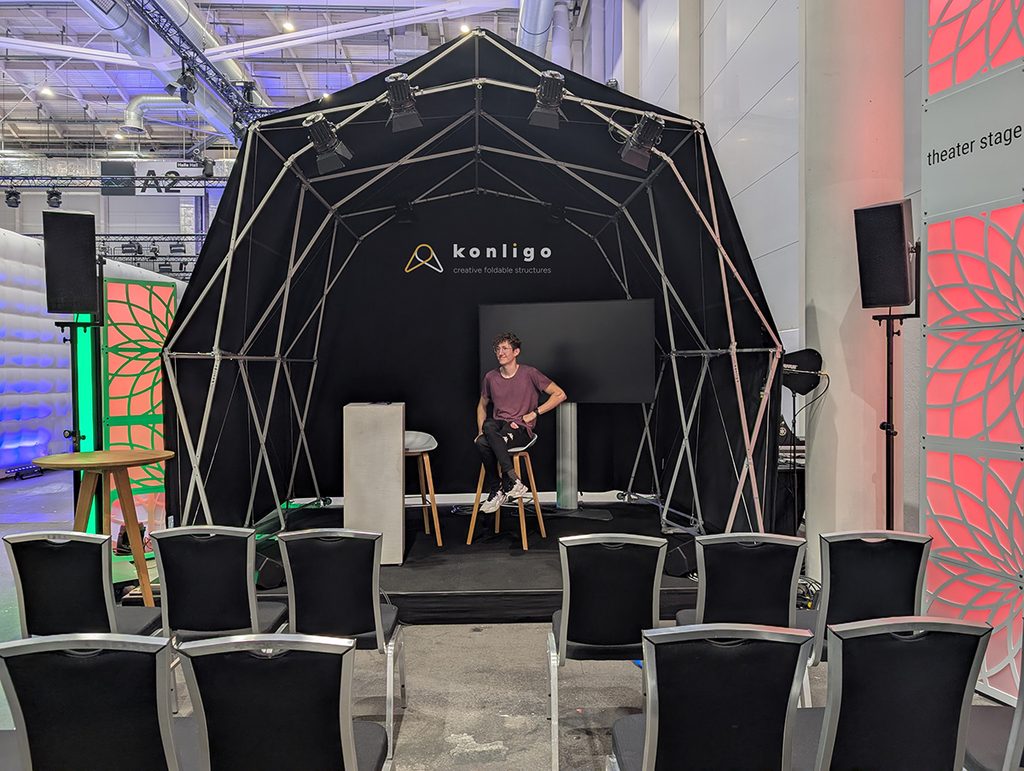
The Tent is a four-by-three-metre foldable structure which it says can be erected within five minutes by one person. Using scissor technology, which involves a criss-crossing pattern of Xs that expand or collapse a structure in a linear direction, the structure can be easily erected and put down as one object rather than requiring additional parts for assembly.
In July 2026, Konligo finished its latest round of investment, raising €1.1m. The announcement came with new strategic partners, including staging and production company MTN Productions and temporary structure specialists beMatrix. The investment will be used to help develop and expand production of Konligo’s newest product.
The brainchild of founder and CEO Aushim Koumar, the company was developed from Aushim’s PhD at the University of Brussels, where he studied scissor technology as more of a theoretical idea. “We looked at how we could transform an academic subject to something more tangible with structural analysis, optimisation and mechanical and civil engineering in order to be used as field hospitals for emergency units,” says Aushim on Konligo’s origins.
After building a prototype structure, Aushim realised the cost would make it difficult for it to be used for emergency relief but that it would work in the exhibition world due to the “new look and feel, because of the easiness, the compactness,” he says.
Konligo decided that the indoor events market alone wouldn’t have the volume of orders it needed, so the company moved into the outdoor sector and started scaling outside of Belgium from 2024.
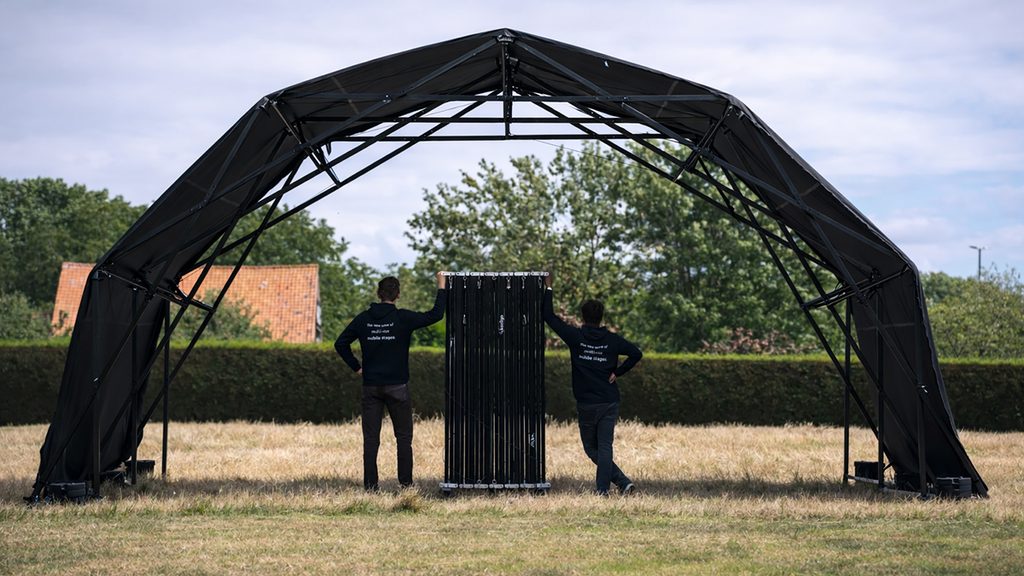
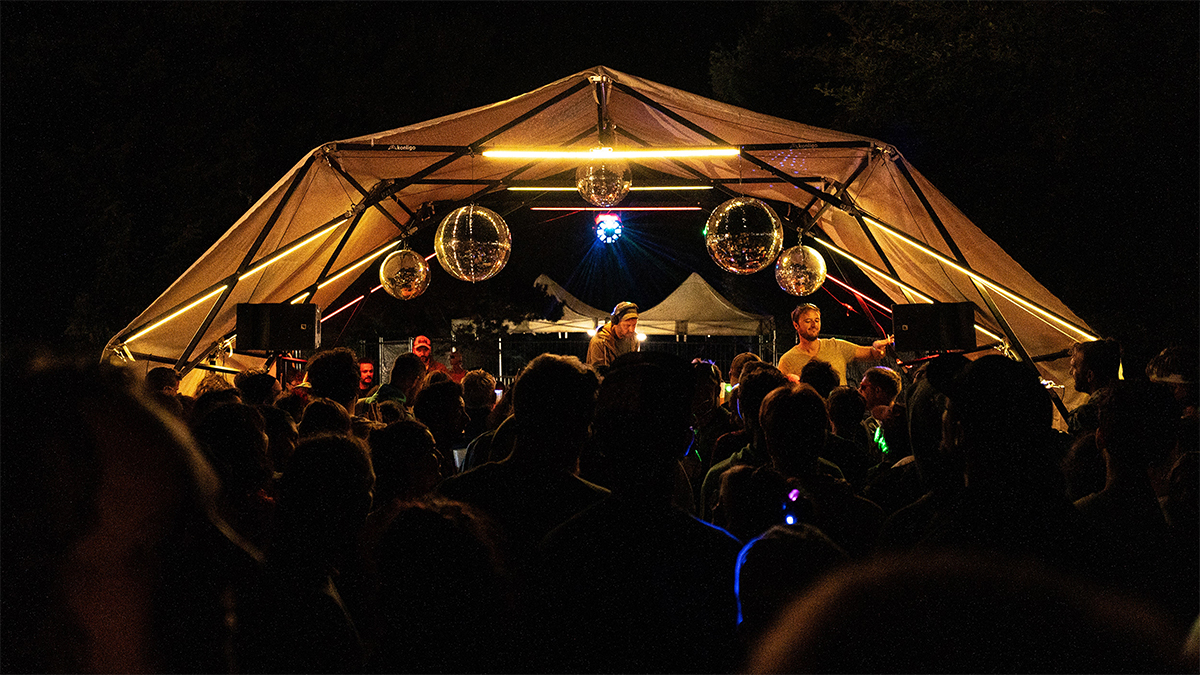
The initial prototype became the Arch, originally called the Fastival, a stage roof available as an eight-by-four-metre or a five-by-four-metre structure which Konligo says can be assembled in 30 minutes by two people.
A large structure with a high price, the Arch showed a gap in Konligo’s portfolio, something they’re now attempting to fill with The Tent. “That’s what was missing in our product line,” says Aushim. “We had quite a lot of brand activation companies that came to us because they liked the design [of the Arch], but they found the product way too expensive for the use case.”
Smaller than the Arch and more visually striking than a traditional festival or conference gazebo, with its geometric structure The Tent doesn’t need the power that inflatable structures do. The Tent is the entry-level product for Konligo, which brands could use at festivals for activations or stall set-ups.
The new investment is being used to scale the Tent and get it into more hands, says Aushim, which he hopes to achieve through mass production. This expansion is to be combined with continued testing within the events sector to see how far the technology can be pushed, with the possibility of bigger domes that could be used with a lift system or a crane rather than people.
“The structure itself is what we call in mechanics one degree of freedom. It means that there is only one way to open it. If you have a crane and you open it, then in each case, it will be opened in the right way,” Aushim explains. “You cannot do anything wrong when you open the structure. So that’s where we want to push it further.”
As well as receiving capital for investment, Konligo also used the investment round to bring on tent manufacturer Veldeman and investment fund Entrevest alongside MTN Productions and beMatrix as strategic partners.
With four companies brought in from different sectors Aushim admits it can be challenging to get everyone on the same page, but he says they “believe in this technology. And even for me, they realise that we didn’t use the capacity of what we have to the fullest.”
Foldable technology is something that Aushim says you have to see before it’s really understood. He admits that sometimes people don’t believe that the Arch can be reliable or robust enough when viewed online, but in person, that’s when people can see how it works organically.
Organisers and event crews who use these products are often used to trussing, the metal traditional foundations of stages and structures, and understand how they work. “I think that’s the biggest struggle in what we’re trying to portray to people,” says Aushim. “People are used to truss systems and are used to what they see. Going for something very different, even if it’s super easy, it’s still a difficult step for people because it is super new.”
That said, Aushim mentions a customer who, every time he sets up the Arch, finds that people around him don’t fully fathom the ease and convenience of what he’s built, something that keeps driving him forward. “There is always a wall but overcoming that is our mission,” he says. “Our vision is that we drive change by creating wonder.”
