

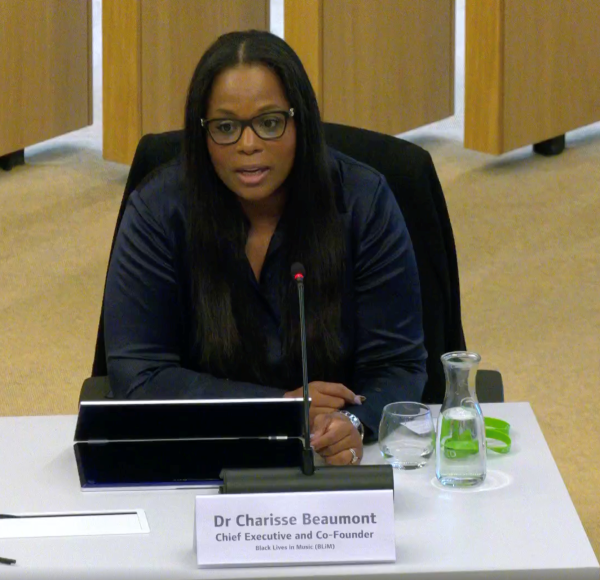
Recently, Charisse Beaumont, CEO of Black Lives in Music, gave evidence to the London Assembly’s Economy, Culture and Skills Committee.
The committee is investigating the strengths and weaknesses of London’s night time leisure sector, its recovery from the pandemic and how it has been affected by rising inflation and cost-of-living.
Black Lives In Music (BLiM) and The Musicians’ Union wrote to the Mayor last year to raise their concerns about barriers in the industry. In response, the Mayor, Night Czar, Black Lives In Music, the Musicians’ Union and LIVE established The Race Equality in Music Event Licensing (REMEL) project to take action. BLiM has been commissioned by the Greater London Authority (GLA), Mayor’s Office for Policing and Crime (MOPAC) and The Musicians’ Union to research the impact of policies and interactions with the police, councils, venues and promoters on Black, Asian and ethnically diverse music events.
Beaumont recounted that when the Licensing Act (2003) was brought in, the responsibility for licensing decisions shifted from magistrates’ courts to local authorities, who were to work in partnership with the police when making licensing decisions. It resulted in cancellation of events without notice, evidence or transparency, particularly with Black and Asian organised events.
Form 696 was used by the Metropolitan Police Service to inform licensing decisions about live music events, asking for details of the ethnicity of the audience and the music genre. The form was banned by the Mayor of London in November 2017 for discriminating against Black and ethnically diverse performers and events. BLiM have been gathering data and stories. They found a cultural venue with mostly ‘Black/Brown’ music programming that, despite the absence of any evidence, have been unable to secure longer hours necessary to make the venue economically viable. However, local pubs will continue to trade, sometimes playing the very music they have been prevented from offering. In some cases, promoters changed their name to a ‘white’ name to secure a licence.
“In one case a large venue called an artist on the day of the event,” said Charisse, “to say they had researched them on the internet and they play hip hop. They feared they would lose their licence, so cancelled the performance. There are other stories of large venues receiving calls from the police advising them to stop a performance. Imagine a small venue or promoter receiving that call, who don’t have the contacts with police and councillors to object. This is what Black and Brown entrepreneurs, promoters and artists face every single day.”
“There are serious barriers to being an entrepreneur for certain communities,” said Charisse, “There was a Bollywood event that was closed down by a licensing officer, just because they could. The organisers lost months of revenue and it destroyed their lives.” “Black and Brown people have a right to work – how much are these cancellations
costing the night-time economy?”
BLiM have found that:
● There are inconsistencies in licensing decisions across different boroughs, with some
demonstrating a risk-averse approach towards BAME applicants and events.
● The night time economy in London is not welcoming to individuals from BAME
backgrounds.
● A lack of transparency in the authorities’ reasons for event cancellations leads to a loss
for the night-time economy.
● The legacy of Form 696 continues to impact the industry – events are cancelled or
subjected to onerous conditions due to racial bias.
● There is a need for a fair and transparent communication between the police and
licensees to ensure accountability and prevent unnecessary event cancellations.
REMEL is chaired by London’s Night Czar Amy Lamé in partnership with Black Lives In Music, The Musicians’ Union, LIVE (the sector body for the live music industry), UK Music, the GLA, London Licensing Managers Forum, the MPS, MOPAC, plus artists, promoters and a representative of the security industry.
