
Gone are the days where a few Facebook posts can sell out a festival. Social media is increasingly geared towards influencers and engagement over being a place to check in with friends. Twitch streamers are now celebrities, and festivals are following suit.
As we saw at this year’s Coachella performances from Justin Bieber and Sabrina Carpenter were choreographed for an at home audience watching on their phones, not just the audiences there in real life. And more recently, Disney+ partnered with Hulu to beam Bonnaroo, Lollapalooza and Austin City Limits across the world.
It’s becoming increasingly clear that those buying the tickets aren’t a festival’s only audience. To speak more on this is Steve Jenner, CCO at TagMix. TagMix is a technology that turns live performances into social media assets that helps drive audience growth, engagement, and ticket sales.
Here, he explains how social media is changing and why festivals need to adapt.
“The festival market is splitting in two.
On one side, events are fighting the toughest trading conditions in years: rising costs, heavier competition, fragmented attention, and audiences slower to commit. On the other, a smaller but fast-growing group are announcing their fastest sell-outs ever.
The outliers don’t appear to have stronger line-ups, locations or legacies than their slower-selling peers. But they do share one less visible advantage. I know this because I’ve spent the last 3 years helping them apply it. The world’s most successful festivals are all running organic content strategies that prioritise real-time engagement during the show, while the audience is fully emotionally invested. The rest of the market are not.
The platform shift that changed everything.
In our opinion, festival marketing budgets have prioritised social media for years following a crude formula: spend to build a bigger audience, reach more people, sell more tickets. This worked reliably until the returns on spend started diminishing, sharply. The mistake many made was to attribute this to ad saturation, soaring CPM rates, living costs or weakening demand.
In reality, the platforms themselves had changed. In a short timeframe with no fanfare, Instagram and TikTok stopped being social networks and became interest networks. They switched from, pushing content to an account’s followers to pushing it to anyone in the universe based on what it is, who’s likely to respond, and how strongly early engagement signals perform. Reach is no longer a function of follower count. Content that earns a fast reaction travels far beyond an account’s existing audience while content that fails has its reach terminated.
This quietly dismantled the central pillar most festival marketing strategies – and budgets – still rest on. The new model says: create stronger content at the right moment, and the platforms find the audience for you.
That’s a profound commercial difference. Producing genuinely engaging content is far cheaper than buying attention from increasingly inefficient paid channels. Yet many festivals are still trying to solve a content problem with media spend, making each ticket sale harder and more expensive to win. Most are not even aware that this is the true root of their struggles.
The technical bottleneck.
The live music experience is by far the strongest selling point any festival has. Historically, it was virtually impossible to turn that experience into high-quality real-time content. The choices were poor: post immediately with camera-mic audio and make the performance sound weak, or wait hours to manually sync professional sound and publish after the moment had cooled. Neither converts a ticket.
That technical bottleneck is now solved. TagMix, whose technology is patented in the US, Europe and China, syncs sound desk audio to live video automatically, in real time, as the performance happens. The gap between quality and speed has closed.
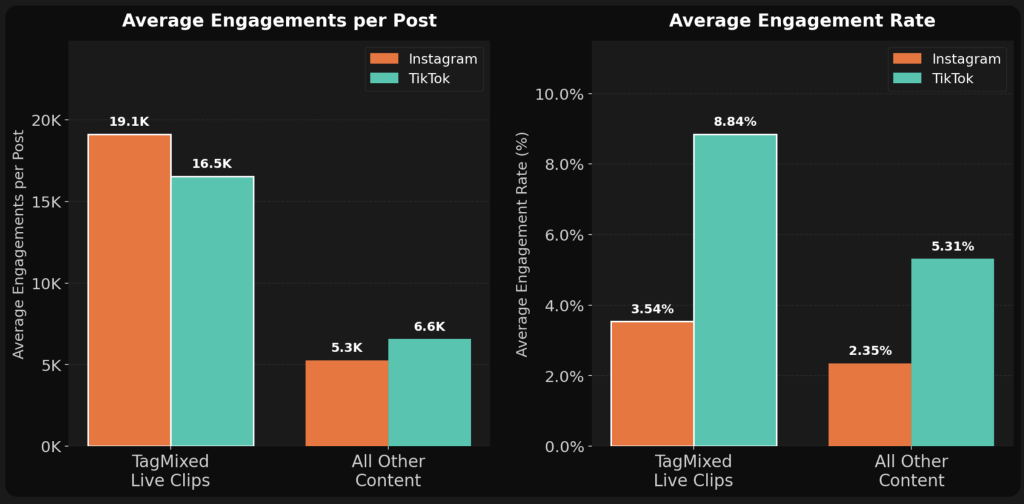
The numbers bear this out. TagMix audited 1,811 posts across 75 of its client accounts in 2025. Real-time clips with professional audio averaged 3.6x more engagements per post than all other content from the same accounts on Instagram, and 2.5x more on TikTok, with engagement rates roughly 1.5x higher on both platforms. A single clip from Lollapalooza Berlin reached 18 million views. That’s the algorithmic shift in raw form: the right content at
the right moment, finding its own audience.
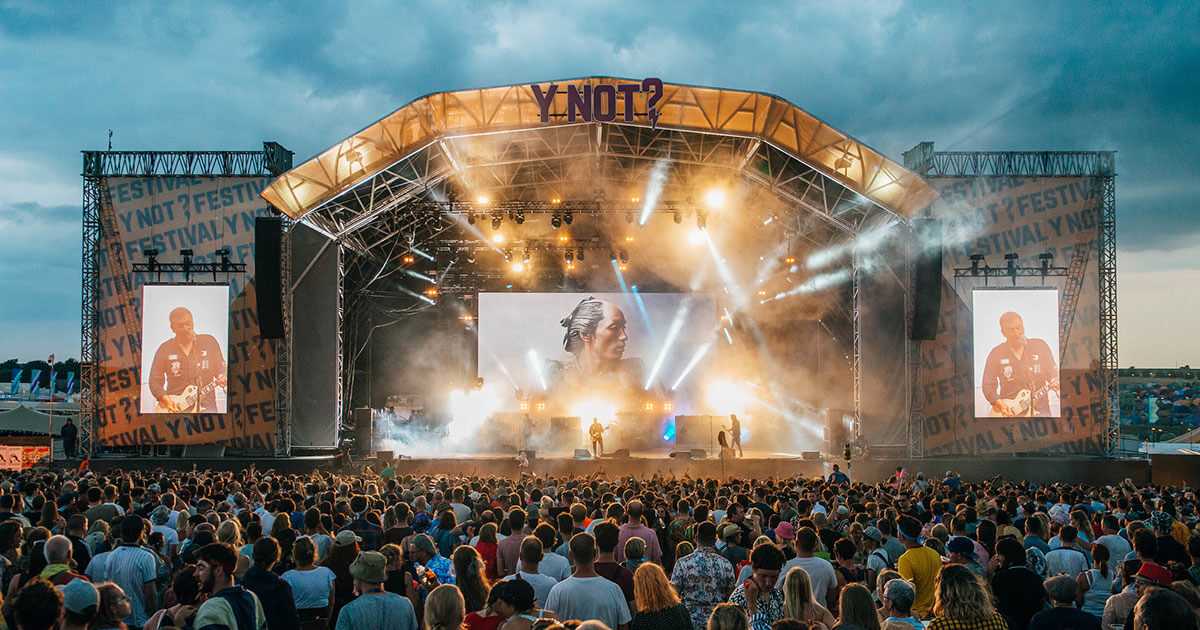
The festivals running this model include Coachella, Lollapalooza, Bonnaroo, ACL, Wacken, Open’er and TRNSMT. It isn’t just a win for the giants. UK independents Y Not, Mighty Hoopla, Tramlines and Reggae Land are seeing the same uplift from the same strategy shift.
The commercial question is whether that engagement converts. Y Not and Reggae Land offer the clearest answer. Both rebuilt their content operations around real-time delivery for 2025. Both have since announced their fastest-ever sell-outs for 2026. Y Not also won Marketing Campaign of the Year at the UK Festival Awards. Reggae Land sold out its original two-day allocation in six hours, then expanded to three days.
Ollie Kverndal, Marketing Manager at Y Not, puts it plainly: “For those who didn’t attend, real-time content creates a sense of FOMO,” says Ollie. “They’re watching it unfold and wishing they were there. That feeling carries directly into ticket sales.”
Brian Murphy, Director at JBM Music and producer of Reggae Land, sees video content shaping perception itself. “It showcases the scale, energy and authenticity of the event in a way that traditional marketing can’t,” says Brian. “It also strengthened relationships with artists, as they could access and share content from their performances almost instantly, amplifying reach organically. Real-time content is now a fundamental part of festival marketing.”
The live weekend used to be the product. It is now the most powerful sales tool a festival has. The winners are the ones acting on it.
If your 2026 show isn’t yet built around real-time content, that is the first decision to make this week. The second is how you’re going to do it.
