


“Hip-hop doesn’t get the same opportunities here compared to other genres, so we need to build the infrastructure around it,” says Richy Muirhead, co-founder and festival director of PITCH Scotland. “We can’t change that overnight, but what we can do is bring people to Scotland and put people into rooms they should be in but aren’t regularly invited in.”
That effort comes in PITCH, a three-day music festival and conference solely focussed on hip-hop and all its many forms. Held in venues across Glasgow, local experimental rap and jazz-tinged beats perform live alongside acts brought in from across the UK, Europe, Canada and beyond.
Through its conference and wider industry programme, PITCH hosts music industry players and thinkers from across the UK to share wisdon while hosting writing workshops, production showcases and more. The greater aims of all this are broad, and are equally about putting music industry eyes on burgeoning talent north of the border while ensuring future generations are being kept inspired.
This pitch to elevate Scottish hip-hop and its many creative interpretations was born through necessity. Richy has been running the Scottish Alternative Music Awards for 16 years, and over that time found that hip-hop was being criminally underserved.
“There’s certainly no shortage of talent here,” says Richy. “So it’s about trying to build an environment where people can have conversations and get feedback on their music or develop an idea. It’s not easy. Nothing in the music industry is, but you can direct and encourage it in the best way possible.“
Scottish hip-hop and, well, any form of rap that isn’t recorded in neutral or American accents gets an undeserved bad rep. For grime, some purists think if it doesn’t come from east London then it’s not authentic. The same is true for Welsh artists inspired by New York boom bap or LA G-funk. If it’s not from there it’s not true to the music, goes the long outdated stereotype.
As PITCH’s programme coordinator and booker, Mobolaji (Mobo) Agoro is very much someone working to change that way of thinking. As well as turning Glasgow into a hip-hop epicentre once a year through PITCH, Mobo manages a roster of Scottish artists breaking through on their own terms.
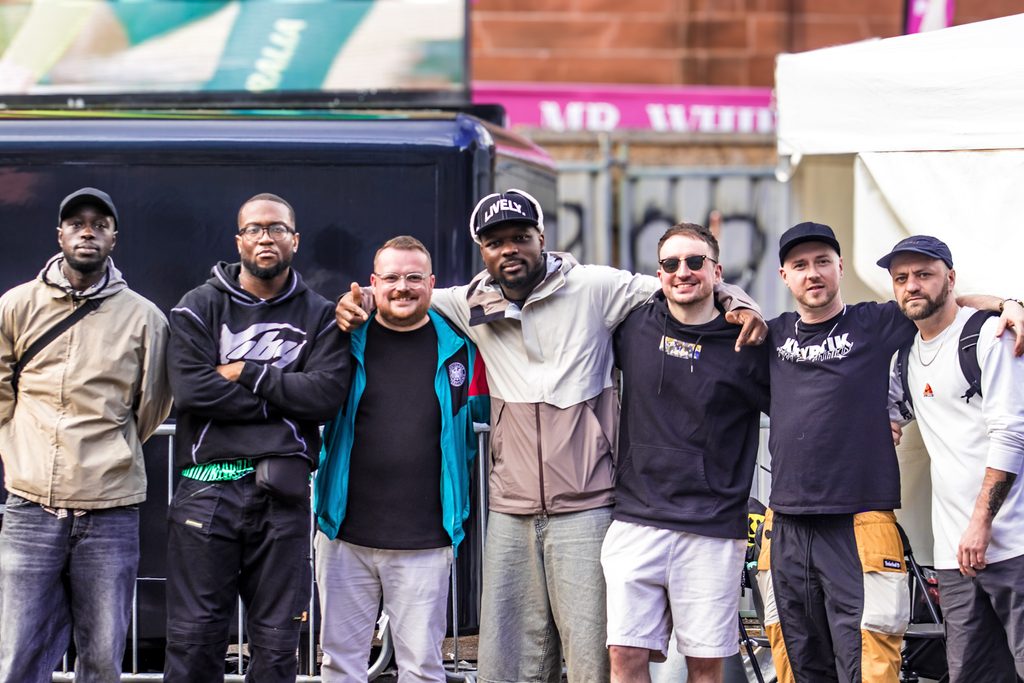
Mobo started in music somewhat accidentally. At university he became frustrated to see that at the club nights he’d go, most prioritised acts from outside the country while overlooking the breadth of talent on Glasgow’s doorstep. From there, he put on open mics and warehouse raves, which eventually lead to him joining PITCH four years ago.
Through his underground, on the pulse experience, Mobo felt like there was something he could add to the then-one day festival, he says. By his own admission, Mobo was somewhat reluctant to let artists from the capital performing at the festival in the beginning. “In the first year I didn’t want any artists from London on the bill,” he says, something that comes from very understandable frustrations.
“Making my early steps in music I realised how flipping hard it was in Scotland, especially for black music genres and artists,” he adds. “There was always a need to prove yourself five times over and try harder.“
Mobo quickly realised that this need to go the extra mile means that sharing knowledge from north to south and vice verse is vital. And through that mantra PITCH is becoming a “destination point where everyone can come together once a year to share knowledge,” says Mobo.
A festival, Mobo goes on to say, is a pretty ideal place to achieve this. “What we have here is a marketplace. And the mentality has always been about highlighting that there’s something going on outside of the capital.“
But while PITCH acts as a place where you can discover new music, it’s a festival which presents a very real pipeline for emerging talent to know there’s equally as real opportunities out there, wherever you’re from.
Through a widespread network of partnerships and cultural exchanges with festivals and organisations such as FOCUS Wales, Centre national de la musique Paris and Canada’s Music Nova Scotia, an interconnected network of overlooked music scenes is emerging.
“An artist that’s maybe just starting to make music can see that there’s a network here,” says Mobo. “There’s layers to it. You can see that maybe in a few years time you could be performing at festivals across the UK, Canada or wherever else.“
This is why PITCH is helping to create a musical hub that is much more local, self-regulating and expressive. “A lot of the work I do is about creating and holding a space for other people to move into. PITCH is one of those spaces,” says Mobo. “It’s an honest representation of what exists here in Scotland, the black populace and the black music genres we have.“
This positive action is seeping into the music itself, and times are changing. More eyes are being brought to acts who proudly showcase their own unique cultures through their art. Richy points to Northern Ireland and bands like Kneecap, who have headlined the likes of Boomtown and AVA Belfast this year despite reaching a very different kind of headline status throughout 2025, in helping this shift towards talent speaking, singing and rapping in their local accents or native languages.
“Hearing artists succeed in their own language will give others the confidence to do the same,” thinks Richy. “Kneecap have definitely shown that you don’t need to dilute or tone down who you are to reach a wider audience.“
Both Richy and Mobo suggest that Scottish rap could have a similar break out moment, their own Kneecap which brings its own take on rap music to the masses. “We’re still waiting for someone to push what we do into the wider stratosphere,” says Mobo, who speaks about the emerging experimental lyricist (and PITCH headliner) Bloody Shield as an artist who could make that happen. “This is a kid from a small village in Fife,” he adds.
All this effort, says Richy, is to create something where musicians and the industry can connect, regardless of if you were born in Glasgow, Fife, Aberdeen or, yes, even London. The added bonus to this is showing artists they can be a future headliner without needing to leave their hometown.
“We want to learn so much from people working in record labels in London and in other countries, and we want that knowledge to be shared up here in Scotland,” says Richy. “But people in Scotland have got a lot to say about a lot of different matters. We have our own story that we want to tell.“
